

The idea of women in bodybuilding, strength sports, and other athletic realms is not that strange. Indeed, many female athletes are broadly celebrated and held up as an aspirational image for women and girls around the world. Though I must emphasize that it is still an uphill battle for women and we are far from gender parity, particularly in the world of physique and strength sports. However in this blog I want to focus on the earliest days of weightlifting to pay homage to the pioneers of strongwoman sport and bodybuilding to mark just how far we have come. Perhaps in a future post I will highlight some strongwomen in the modern era.
Early Strongperson’s performances were typically an offshoot of the circus or Vaudeville shows, serving as another spectacle to entertain and wow audiences. As a result, shows often featured some sort of amazing act by the strongperson, such as catching cannon balls fired from a cannon, lifting an elephant or horse (depending on what you could get your hands on) and other seemingly impossible feats of strength. The goal was to draw a crowd, so there was often a lot of showmanship, exaggeration, trickery, and probably some good old-fashioned lying, all in the name of getting the public to part with their hard earned cash. In that way it’s not so different from what fitness influencers do on Instagram and TikTok, albeit with a bit more flair.
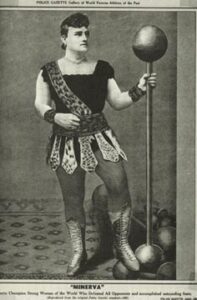
Our first strongwoman is the indomitable Josephine Schauer Blatt, famous under her stage name: “Minerva”. Birth records from the nineteenth century can be mysterious, and there are differing accounts of her early life. She was born in 1869 either in New York or Hamburg, Germany. Being one of our earliest examples of a strongwoman, her career largely involved grand performances on the Vaudeville circuit and in circuses as well as wrestling. The key to these performances center around your ability to draw a crowd; the bigger the crowd, the more money you make. How do you draw a crowd? I’m glad you asked! You draw a crowd by conceiving of wilder and wilder demonstrations of your impressive strength. If the strongman down the street can catch a cannon ball launched straight from the cannon then what about lifting the whole cannon using only your teeth?! You build buzz by offering challenges to other strongwomen, live competitions where you try to lift more than your opponent.
For Minerva’s audience, much of the initial draw would have simply been the opportunity to see a woman participating in such demonstrations of “masculine power”. She certainly wasn’t the only woman who found a calling in being strong, but it would have been extremely rare and by all accounts she was probably the strongest woman at the time. Some of her many feats of strength included the aforementioned catching of cannon balls and lifting of cannons with her teeth, she also reportedly lifted a horse with one finger, and did a “belted platform lift” of 18-23 men totalling somewhere around 3000 lb. “But how!?” you might say. “The strongest men in the world in the modern day can’t do such things! It beggars belief!” True, but it caught your attention, didn’t it? Keep in mind that these were circus performances; there wasn’t much in the way of rules and governing bodies. My guess is that there was some level of trickery and numbers were definitely inflated. This is not to take anything away from Minerva’s performances as they still certainly required an enormous amount of strength and skill. Think of it a bit like professional wrestling today: highly scripted, very flashy, with little tricks here and there to sell the performance but all of that still requires significant athleticism and commitment.
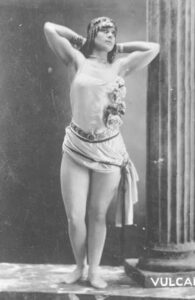
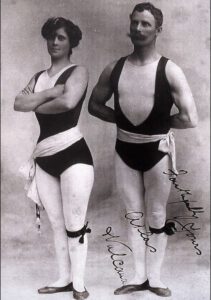
Our second woman of great commitment is Kate “Vulcana” Williams. Born in 1874 in a small town in Wales, her life of adventure started early. At the age of 15 she met William Roberts, better known as “Atlas.” At the ripe old age of 26, he was already an established strongman, touring the music halls putting on performances exhibiting his physique and strength. As the story goes, they fell in love and she ran away from home to join him in London and begin her career as a professional strongwoman. Now, questionable age of consent aside, Atlas was also already married and had a child, so we can add that to the list of scandalous facts about Vulcana’s life. Apparently, their solution to avoiding rumors was to present themselves as brother and sister. Do you remember the band The White Stripes? Anyway, they did spend the rest of their lives together and have six kids and by all accounts were deeply in love, remaining with each other until they both died in the same year.
But enough dry biographical detail, now on to the feats of strength and heroism! Vulcana was said to have been awarded over 100 medals, with her favorite having been presented by the Queen of Holland. I was unable to discover what specifically she did to win that one but I bet it was cool. She and Atlas took their show on the road and performed in venues all around Europe as well as parts of Arabia and even as far as Australia. Surprisingly, we only have one surviving photo of her lifting anything but it is a picture of her lifting a man over her head with one hand, so I suppose if we can only have one action shot, that one is pretty good.
Vulcana had the opportunity to use her strength for more than lifting heavy objects and impressing crowds. In 1901 she dove into the river Usk to save two kids from drowning. Later that year she helped a stuck wagon by lifting it out of the rut it was stuck in. While in Australia, she was on a train riding in the women only car when a man came in and decided to try and harass the women. When Vulcana confronted him and told him to take a hike he insisted that he could “go anywhere he liked”. She swiftly picked him up and tossed him off the train as it was pulling away from the station. On a more serious note,Vulcana was friends with Cora Crippen, a music hall singer who performed under the stage name Belle Elmore. When Cora disappeared in 1910, her husband, Hawley Crippen claimed she simply moved from London to California and then suddenly died there. Vulcana was suspicious about her friend’s death, especially since the “grieving” widow moved his mistress into his home immediately upon his wife’s disappearance. Vulcana insisted the authorities investigate Crippen, eventually leading to his capture as he was attempting to flee to Canada. Though not specifically related to her physical strength, I felt it was none the less an act of heroism worth reporting.
Kate “Vulcana” Williams continued to perform into her 50’s, finally retiring in 1932. In 1939 at 64 years old she was hit by a car and gravely injured. As the story goes, she was conscious but couldn’t move or speak, and even heard herself pronounced dead! It was not until she was on a cold slab being prepared for burial that an attendant at the morgue noticed a tear running down her face indicating that she was, in fact, alive. Although she survived, she did suffer some brain damage and was never quite herself after. She died in 1946 at age 72; Atlas died the same year at age 83.
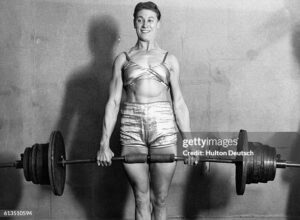
Now on to our final strongwoman, the singular Ivy Russell. No stage name here, just Ivy Russell. Born 1907 in Croydon, England, Ivy was just three lbs at birth and suffered many illnesses throughout childhood. At 14 she was frail, suffered from asthma, and was reportedly on the verge of developing tuberculosis. (At this time anyone who was deemed sufficiently frail and exhibited other signs such as swollen glands or poor respiration would be considered “on the verge of developing tuberculosis,” as opposed to having the specific bacterial infection that we now know causes tuberculosis.) Rather than accepting her fate as a delicate waif, she began working with E.A. “Ted” Streeter who started her out with breathing exercises and light jogging to improve her constitution. By 16 her health had improved enough that Streeter introduced her to gymnastics and something called “acrobatic hand balancing” which I believe is more or less exactly what it sounds like. Also, she took up boxing, a woman after my own heart. By 18 she had become an avid weightlifter and is credited with performing a 176 lb clean and jerk while she weighed only 134 lbs. Seven years later in 1932, Ivy challenged another English strongwoman by the name of Tillie Tinmouth, whom she beat by lifting a 300 lb barbell overhead. To put this in context, the current recognized world record for this lift by a woman is 300 lbs.
In spite of her obvious strength and athleticism, as is often the case for women in a male-dominated field, she spent quite a bit of time pushing back against a patriarchal society that insisted women should not be strong and lift weights, that it was dangerous for them and threatened a moral society, etc., etc., etc. The fitness organizations of the time denied her membership and refused to recognise her accomplishments including the above mentioned challenge. In some ways it seems like Russel faced more official sexism than our previous two subjects. Perhaps this was due to Minerva and Vulcana being viewed as more of an oddity, given more leeway as “circus” performers, whereas Ivy was part of a growing interest among women in strength training.
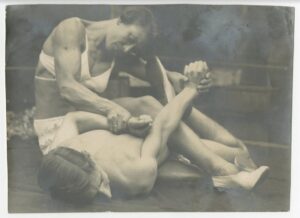
After being crowned the strongest women in England following her competition with Tillie Tinmouth, Ivy sought out further challenge in the ring as a wrestler. Here again she issued a challenge which in 1934 was accepted by Miss Peggy Parnell. Parnell was a more experienced wrestler but was also a full 6 inches shorter and lighter than Ivy. Prior to the match, she was quoted as saying “I am banking on my superior experience beating Miss Russell’s physical advantages,” however her experience would not prove to be up to the challenge. Ivy was able to achieve 2 out of the 3 planned submissions in less than 10 minutes, making her the first female wrestling champion of Britain.
Ivy continued her career in wrestling as well as lifting, even setting a deadlift record of 369 lbs, and later beating her own record with a 385 lb lift. Sadly, her athletic career and public life ended rather abruptly in 1939, when she and two other women were in a car crash. Ivy survived, but one of the other passengers did not.
I think Ivy Russel was my favorite of the three women I highlighted here and I’d love to learn more about her in particular. Perhaps I will revisit her in a future post. Speaking of future posts, did I ever tell you about Rachel McLish, the winner of the inaugural United States Championship in bodybuilding and the winner of the first Ms. Olympia competition?

Leave A Comment